Managing Bid-Package Document Chaos: Drawing Revisions, Addenda, and the Real Preconstruction Bottleneck
Drawing revisions, addenda, conflicting specs — why bid-package document control eats 2-3 days per bid, and what AI realistically compresses (and doesn't). Free companion whitepaper.
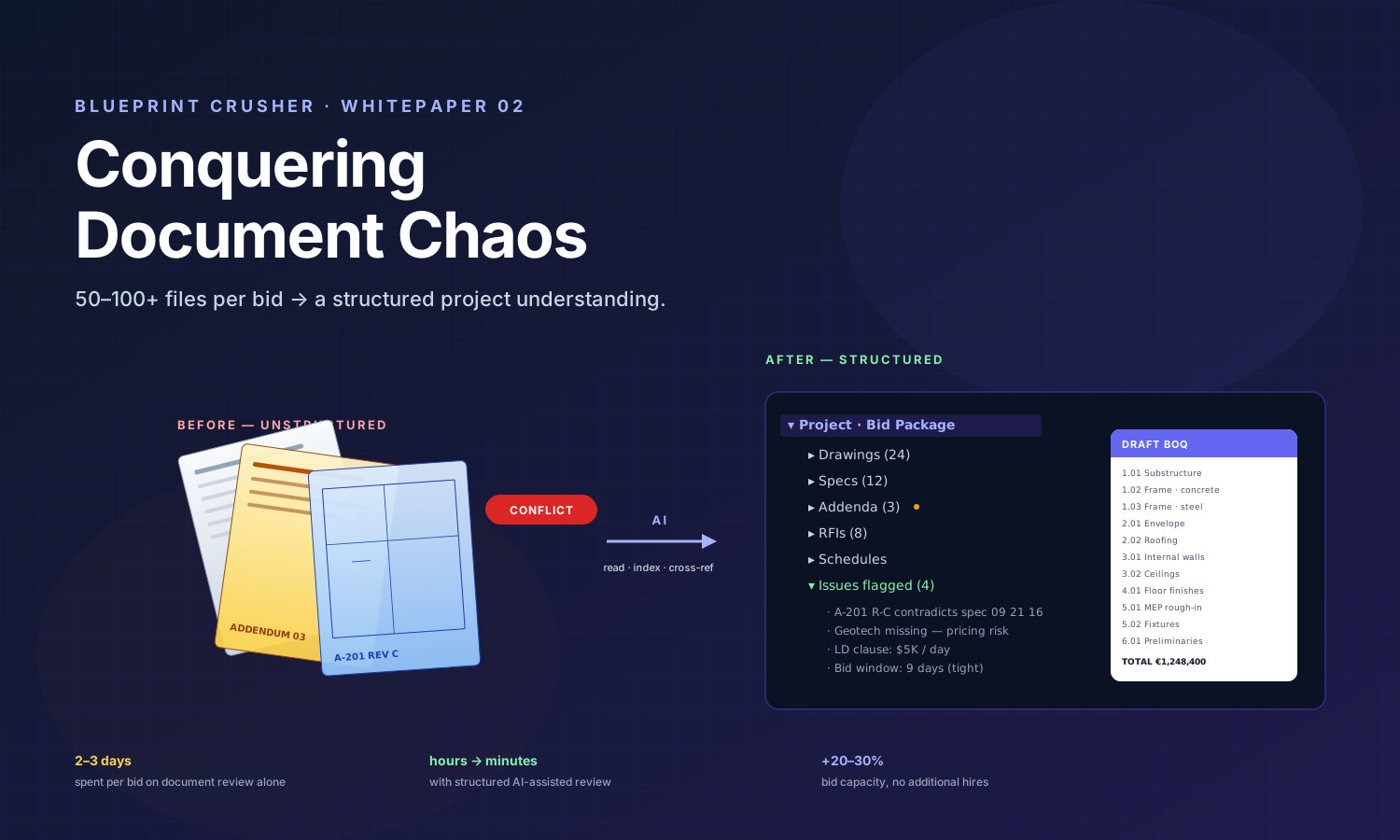
Ask an estimator what they spend their day on, and the visible answer is takeoffs and pricing. Ask them what eats the clock, and a different answer surfaces: reading documents. Reconciling drawings against specs. Tracking which addendum supersedes which. Locating the current revision of a drawing across a folder with seven versions of it.
That upstream block — the work no client ever sees — is now the single largest time sink in preconstruction.
What’s actually in a modern bid package
Fifty to a hundred-plus files is now routine for a single bid. Drawings revise. Specifications contradict the drawings. Addenda override both. A single answer — “what insulation are we pricing on the east elevation?” — can require five cross-references across three documents that don’t agree with each other.
The numbers tracking this are sobering:
- 50–100+ files in a typical bid package today
- 2–3 days often spent per bid on document review alone, before any number is entered
- Hours → minutes — what modern teams now expect from early-stage document analysis
If the initial understanding of a project is flawed, the estimate built on top of it will be flawed too — no matter how good the pricing engine.
Why “work faster” and “hire more” don’t fix it
When estimating becomes the bottleneck, two reflexes follow. Neither scales.
Push the team harder. Drives burnout, increases errors, produces inconsistent pricing. Quality drops first; volume follows.
Hire more estimators. Adds overhead, lengthens onboarding, multiplies variability. A second estimator inherits the same broken upstream workflow.
The shared blind spot: both treat estimating as the constraint. The actual constraint is the document-understanding work that happens before estimating starts.
The reframing: the bottleneck is not how fast your team estimates. It is how fast they can understand a project well enough to begin.
What AI actually does (and doesn’t do)
AI will not replace estimators or quantity surveyors. Pricing judgment, supplier relationships, risk reads, commercial strategy — those stay with the human. What AI does well is the upstream block.
Rapid document review. Reads a full bid package — drawings, specs, addenda, exhibits — in minutes. Extracts scope, locates references, produces a structured starting point instead of a blank folder.
Conflict and gap detection. Highlights inconsistencies between drawings and specifications, missing information, and clauses that warrant attention before pricing — including which drawing revision is current and which addendum supersedes which.
BOQ / SOV assistance. Drafts an initial bill of quantities or schedule of values from the package, giving the estimator a starting structure rather than a blank sheet.
Not final pricing or risk decisions. Subcontractor selection, market-driven pricing, commercial strategy, and risk acceptance remain human judgment. AI clears the runway. The estimator still flies the plane.
The shift is from finding to deciding. Same person, same expertise — applied to a different, more valuable, part of the workflow.
Five steps you can take this month
Each step is independent. None require buying anything.
- Introduce a qualification checklist before the takeoff begins.
- Set a clear Go/No-Go threshold — make “No-Go” a respectable, tracked decision. (See the Go/No-Go framework for what to score against.)
- Measure time spent per bid on document review. You cannot compress what you do not measure.
- Standardise the workflow — reuse structures from past projects. Repeatable is faster, more consistent, easier to improve.
- Prioritise clarity early — invest the first hour of every package in structured understanding. The rest of the bid moves faster when that hour is well spent.
Tools accelerate these steps. They do not replace them. Start the discipline first; layer AI-assisted review on top once the process is in place.
Read the full playbook
This post condenses our executive brief on the topic. The full document-chaos whitepaper covers a mid-sized contractor case example (before/after numbers), the practical limits of current AI in preconstruction, and how to sequence the five steps so each one compounds the next. It’s ungated — no form, no email, just the PDF.