How Subcontractors Decide Which Projects to Bid: A Practical Go/No-Go Framework
A practical Go/No-Go decision framework for subcontractor estimators: 4 criteria, 5-point checklist, and the structural reasons bad bids slip through. Free companion whitepaper.
If you ask a high-performing subcontractor estimating lead what their biggest waste is, most will not say “we lose too many bids at the bid table.” They will say something more uncomfortable: we spend too many hours on bids we should never have started.
That is the bid-or-no-bid problem — and it is structural, not a discipline issue.
The real cost is the bid you never started
Across firms handling 8–10 invitations a month, a meaningful share of estimating capacity gets consumed by opportunities that were never likely to win, or were never a fit in the first place. Each one displaces a better-fit opportunity that arrived in the same week. The lost revenue is not the deal you almost closed. It is the deal you never had time to pursue properly.
Most teams already sense this. What they lack is a fast, documented way to act on it before they are already 15 hours into a takeoff and feeling the sunk-cost pull of “we might as well submit something.”
Why bad bids slip through (it’s not your team)
Four structural reasons, none of which are fixable by telling estimators to “be more selective”:
- Pipeline pressure. Sales, operations and ownership all want a fat pipeline. Saying no to a tender feels like saying no to growth.
- No written process. Most firms have no documented qualification step. Decisions live in the head of whoever opens the package first.
- Information buried in 300 pages. The things that should disqualify a project — onerous flow-down terms, missing drawings, unrealistic milestones — sit deep in the package.
- No fast way to scan risk. The only way to surface problems is to start estimating. By then, walking away costs more than finishing.
The pattern: teams react to whatever lands in the inbox. High-performing teams decide, in the first hour, which packages deserve another hour at all.
The 4-criteria framework
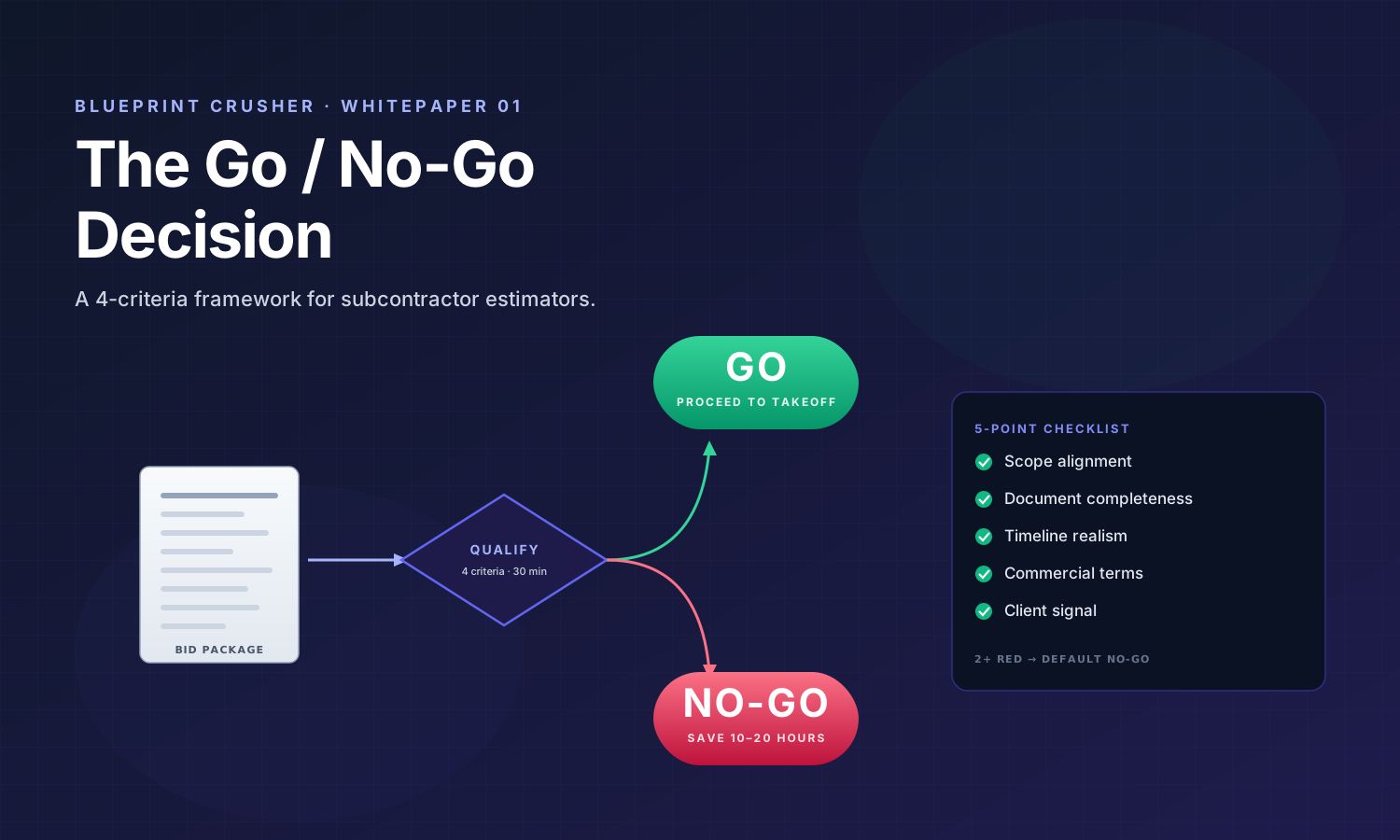
Four questions, answered before any takeoff begins. The output is binary — Go, or No-Go — with a documented reason either way.
- Strategic fit — Does the scope match what we genuinely do well? Sector, building type, delivery method, geography and size. A close miss on any one usually erodes margin even when the bid wins.
- Documentation quality — Is the package complete enough to price with confidence? Drawing and spec coverage, addenda, RFI history, geotech. Gaps become contingency — or claims.
- Schedule feasibility — Is the bid window and the construction programme realistic? An unrealistic deadline at bid stage usually signals one at delivery too.
- Client and commercial seriousness — Is the buyer credible, and are the commercial terms acceptable? Payment, retention, LDs, named insurance, flow-down clauses. Dealbreakers stay dealbreakers — find them before the takeoff, not after.
The 5-point checklist
Use this on every package. If two or more answers are red, default to No-Go.
- Scope alignment — does at least 80% of the work fall inside core capability?
- Document completeness — are drawings, specs and addenda consistent and current?
- Timeline realism — is the bid window long enough to price properly?
- Commercial terms — any dealbreakers in payment, retention, liability, flow-down?
- Client signal — funded, likely to award, no history of fishing for prices?
A 30-minute structured pass on these five points routinely saves 10–20+ hours of wasted estimating effort per disqualified opportunity.
Make “No-Go” a respectable answer
Teams qualify better when declining a bid is treated as a positive contribution. Track No-Go decisions, including the reason, so the discipline becomes visible and rewarded. The firms that grow fastest are not the ones that bid the most — they are the ones that decide, fastest, what not to bid.
Read the full framework
This post is a condensed version of our executive brief. The full Go/No-Go decision framework whitepaper covers the structural why behind each criterion, downstream effects on win rate and estimator wellbeing, and a one-page printable checklist. It’s ungated — no email required, no form, just the PDF.
Related: Conquering bid-package document chaos — the companion paper on why document review (not takeoff) is the real bottleneck in preconstruction.