Europe's Heatwave Is a Reminder: Construction's Carbon Reckoning Has Arrived
The future of construction estimating isn't just about cost—it's about carbon. As Europe moves toward stricter embodied carbon and Whole Life Carbon reporting requirements, contractors, developers, and design teams will need new tools to evaluate sustainability alongside budget and performance. In this founder-led perspective, we discuss why carbon accountability is becoming a competitive advantage, how early-stage project decisions influence long-term emissions, and how Blueprint Crusher is helping bring carbon intelligence into the estimating process through AI-powered material and procurement insights.
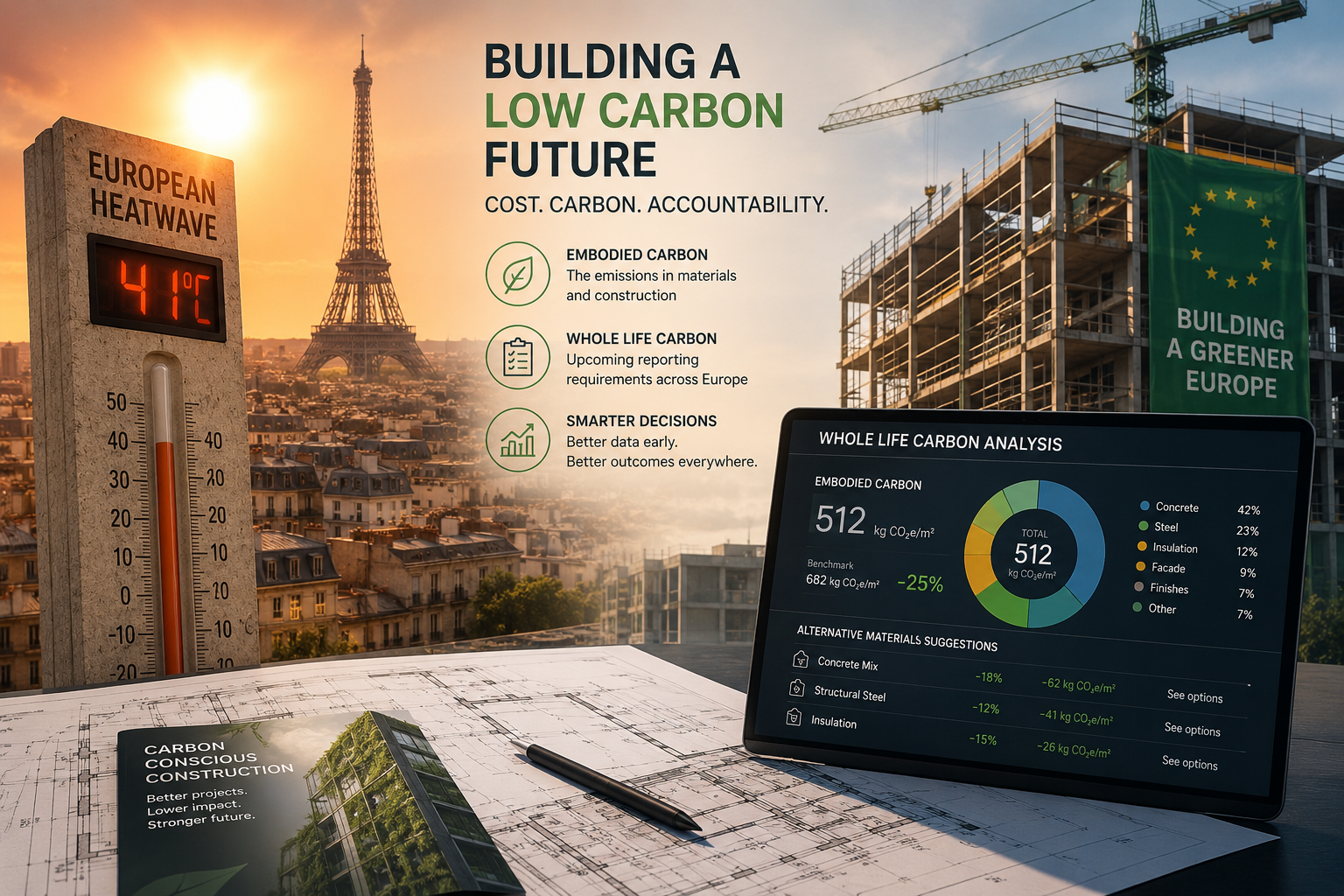
As much of Europe endures another summer heatwave, conversations about climate change have once again moved from academic debate to everyday reality. Rising temperatures, strained infrastructure, and increasing pressure on governments to meet climate targets are forcing industries to rethink how they operate.
Few industries sit more squarely in the spotlight than construction.
Buildings and construction account for nearly 40% of global CO₂ emissions, making the built environment one of the largest decarbonization opportunities in the world. For decades, sustainability efforts focused primarily on operational emissions, the energy consumed to heat, cool, and power buildings after they were occupied. But a major shift is underway.
Governments, developers, and regulators are increasingly turning their attention to embodied carbon.
Embodied carbon refers to the emissions generated through the extraction, manufacturing, transportation, installation, maintenance, and eventual disposal of construction materials. In many projects, these emissions represent a substantial portion of a building’s total carbon footprint before the first tenant ever moves in.
This shift is already influencing policy across Europe.
As Whole Life Carbon reporting requirements and embodied carbon regulations begin to emerge across European markets, developers, contractors, and design teams will face growing pressure to understand not only what a project costs, but also the carbon impact of the materials and systems they select. Countries such as Denmark, France, and the Netherlands have already taken steps toward embodied carbon measurement and limits, while broader European initiatives are pushing the industry toward greater transparency and accountability.
For the construction industry, this represents more than another compliance requirement.
It represents a fundamental change in how projects will be evaluated.
The challenge is that most carbon decisions are made surprisingly early.
By the time a project reaches construction, many of the largest embodied carbon decisions have already been locked in through design choices, material specifications, and procurement strategies. Yet the estimating and preconstruction phases have traditionally focused almost exclusively on cost, availability, and constructability.
Carbon has often been treated as an afterthought.
We believe that is about to change.
The future estimator won’t simply answer the question, “How much will this building cost?” They’ll also be expected to answer, “What is the carbon impact of building it this way?”
For innovation leaders, developers, and investors, this creates a significant opportunity. The companies that can bring carbon intelligence into the earliest stages of project planning stand to become critical infrastructure for the next generation of construction workflows.
That’s one of the reasons we began expanding Blueprint Crusher beyond traditional estimating.
While our platform was originally developed to help contractors analyze tender documents, accelerate bid preparation, and improve estimating accuracy, we’ve increasingly focused on helping teams understand the sustainability implications of their decisions much earlier in the project lifecycle.
We believe the estimating phase is where many of the most important sustainability decisions are actually made.
Material selections, specification alternatives, procurement choices, and scope decisions can dramatically influence a project’s embodied carbon profile. Yet many project teams still lack the tools to evaluate those tradeoffs while they are actively pricing work.
Using AI, Blueprint Crusher can identify opportunities to consider alternative materials and construction approaches that may reduce embodied carbon while still meeting project requirements. Instead of viewing sustainability and cost as competing objectives, we believe project teams should be able to evaluate both side by side.
The goal isn’t to replace the expertise of architects, engineers, quantity surveyors, or sustainability consultants. It’s to provide earlier visibility into opportunities that might otherwise be missed.
This perspective is informed by our team’s background in both construction and sustainability.
Our Head of Product, David Ryan, has spent more than two decades working in construction and has been actively involved with the Green Building Association of Ireland. Through that experience, he saw firsthand how sustainability goals often collide with project timelines, budgets, and procurement realities. One recurring challenge stood out: by the time carbon considerations entered the discussion, many of the most important project decisions had already been made.
Technology alone won’t solve the construction industry’s sustainability challenges. Better standards, better datasets, and better collaboration will all be required.
But we do believe AI can help move sustainability from a reporting exercise to a decision-making tool.
For investors and innovation teams, the convergence of AI, construction productivity, and sustainability compliance represents one of the most compelling opportunities in the built environment today. As regulatory requirements continue to expand and clients increasingly demand measurable sustainability outcomes, the ability to understand both cost and carbon during preconstruction will become a competitive necessity rather than a differentiator.
The construction industry is entering an era where cost and carbon will be evaluated together.
Companies that begin building those capabilities today won’t simply be better prepared for future regulations, they’ll be better positioned to win projects, reduce risk, and compete in a market where sustainability is becoming a core business requirement.
The question is no longer whether carbon accountability is coming to construction.
The question is who will be ready when it arrives.