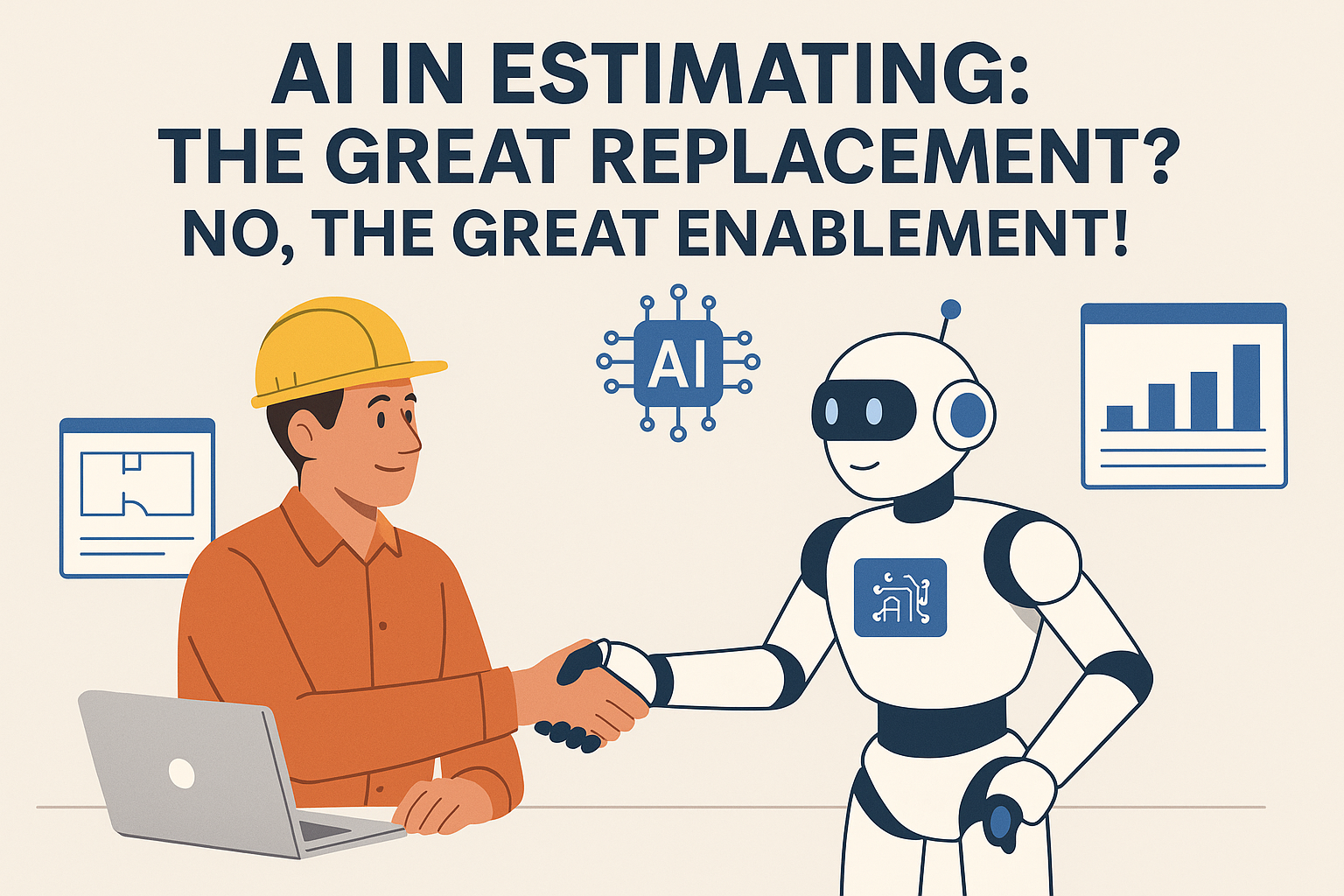
AI in Estimating: The Great Replacement? No, The Great Enablement!
It’s easy to feel a knot of worry when you see new software promising to measure complex sites or crunch project costs instantly. For surveyors and estimators who have built careers on their knowledge and keen eye, the thought is simple: Is a piece of code going to swipe my job? This isn’t just about efficiency; it’s about the security of a paycheck and the value of years of hard-earned experience.
It’s been a while since I was in college but a recent chat with some ambitious Quantity Surveying students really struck a chord. While they were buzzing with excitement about getting out there into the work place there was an underlying tone of anxiety—the fear that Artificial Intelligence might be measuring up to take their careers before they even begin.
To those students my advice was this, Don’t Fear the Tool, Master It
It’s natural to feel threatened when a powerful new technology emerges, but my answer to that fear is simple: The robot isn’t coming for your job; the quantity surveyor who uses the robot is.
We must adopt a new mindset: AI in construction and surveying isn’t a replacement for human judgment; it’s a monumental power tool. Think of how the spreadsheet revolutionized accounting, or CAD transformed drafting—these tools didn’t eliminate the professions, they made them faster and more precise.
The key to professional longevity is to adopt these new AI-driven programs and applications as soon as they become available. This will move you from time-consuming, low-value tasks to high-value decision-making. You must also integrate with it. Learn how to feed the AI reliable data and, crucially, how to validate its output. Your human expertise—your knowledge of site conditions, supplier reliability, and complex negotiations—is the critical filter that ensures the AI’s speed translates into an accurate, buildable estimate. Don’t wait for your company or competition to force your hand; be the one leading the charge of innovation. Become the office expert on drone-based site mapping or machine learning-driven cost modeling. When you master the tools, you position yourself as indispensable, not just competent.
The Human Element Remains King
AI can process data, but it cannot yet perform complex stakeholder communication, navigate politically sensitive contractual disputes, or apply local knowledge and professional intuition based on years of experience. By mastering the new tools, you free up time to focus on these critical human-centric skills that no algorithm can replicate. The future of surveying and estimating belongs to the professionals who understand that AI doesn’t diminish their expertise—it amplifies it.
The Final Takeaway: Enablement, Not Replacement
So, let’s put that pervasive student anxiety to rest. The advancements in AI for our sector are not the start of “The Great Replacement,” where human professionals are systematically phased out.
They are, unequivocally, the start of “The Great Enablement.”
By embracing these tools, we aren’t losing our jobs; we are shedding the tedious workload and gaining the power to deliver projects faster, more accurately, and with greater insight than ever before. The choice is yours be enabled by AI or be left behind.