Glossary — Concepts
The six core concepts in Blueprint Crusher: Product, Price, Rate, Assembly, Takeoff, and Estimate.
Concepts
Before the how-to, here’s the vocabulary used throughout the app. Six terms — read them once and the rest of the docs will read like English.
Product
A single thing you buy or supply — a bag of cement, a metre of copper pipe, an hour of carpenter’s labour, a day of excavator hire.
Each product has a base unit of measure (UOM) — the unit you ultimately price per (per m, per m², per hour, per yd³). Products live in your Rate Library and are reused across every project.
Price
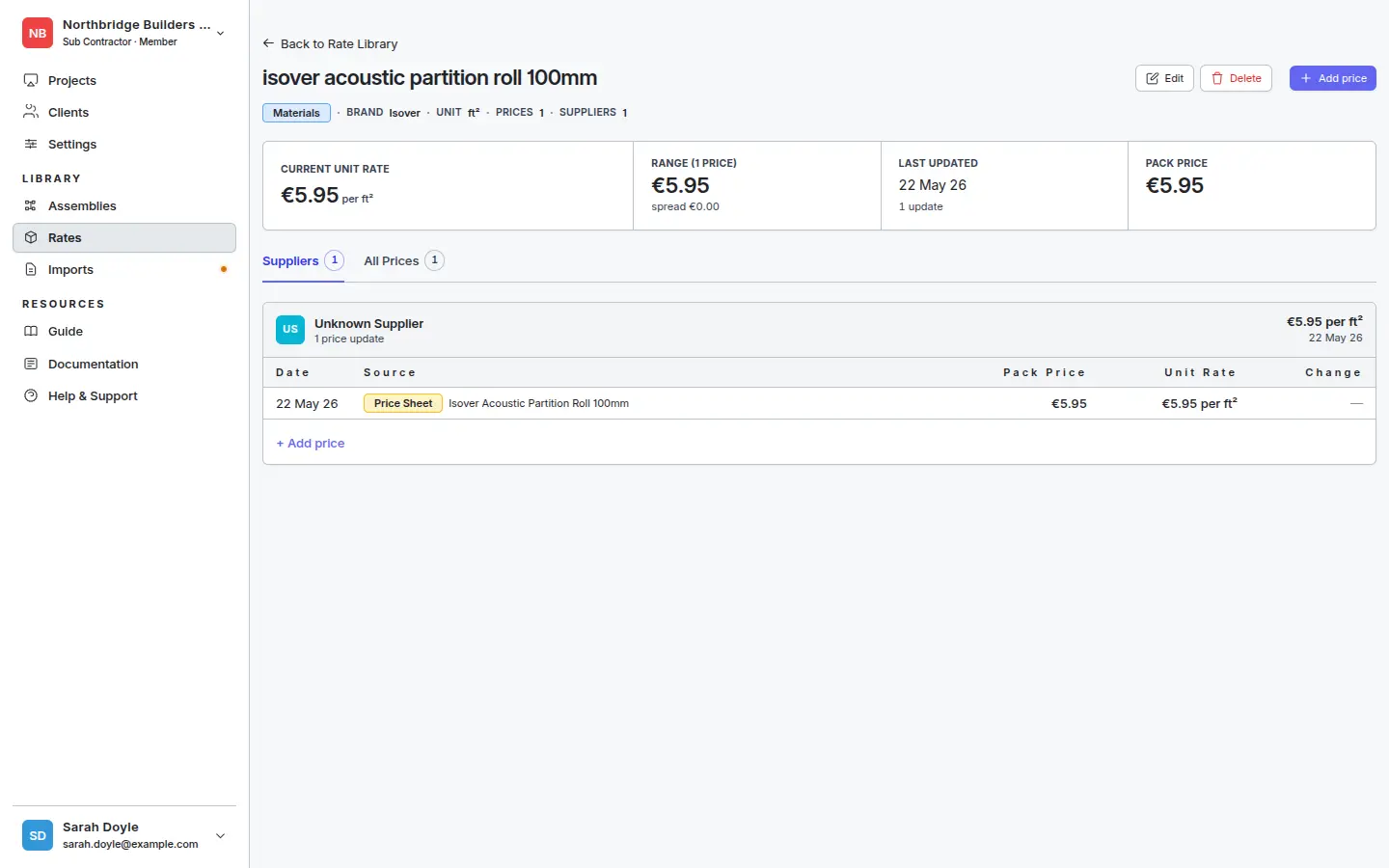
A product can have many prices — one per supplier, per effective date. A price records what you actually paid (or were quoted) for a particular pack from a particular supplier on a particular day.
Two numbers per price matter:
- Pack price — what the supplier charges you for the pack as sold (e.g. C$79.50 for a box of 50).
- Unit rate — the normalised cost per base UOM (e.g. C$1.59 per No.). This is the number that flows into your estimates.
The system stores every price you’ve ever entered, so you keep a full history and can see how a product’s cost has trended over time.
Rate
A rate is the price-per-unit you charge (or budget) for one line of work in an estimate — e.g. “supply and install 100 mm reinforced concrete slab — C$185 / m²”.
A rate can be:
- Direct — typed in by hand, or copied from a single product’s unit price.
- Built from an assembly — calculated automatically from a recipe of products + labour + waste. This is the recommended approach because the rate updates as costs change.
Assembly
An assembly is a reusable formula that combines several products into one composite rate. Think of it as a recipe:
100 mm reinforced concrete slab (per m²) = 0.10 m³ concrete + 12 kg rebar + 0.05 hr formwork-carpenter + 0.08 hr labourer + 5 % waste
You define the assembly once. After that, any time you need a slab rate in any project, you apply the assembly and it computes the rate from current product prices. Update a supplier price and every assembly that uses that product reflects the new cost the next time it’s applied.
Assemblies can use variables — named inputs like {block_thickness_mm} or {render_thickness_mm} — that let one assembly cover many cases. A single blockwork-wall assembly with a {block_thickness_mm} variable can produce a 100 mm rate, a 140 mm rate, or a 215 mm rate without you copying it three times.
Takeoff
The act of measuring quantities off a drawing — areas, lengths, counts. A takeoff produces how much of each work item is needed; assemblies (or direct rates) turn that into what it costs.
Estimate
The priced schedule of work for a project — a list of items, each with a description, a quantity, a unit, a rate, and a total.
Some industries call this a bill of quantities, cost plan, or pricing schedule — they all mean the same thing. An estimate is what you send to a client to win the job, and what you compare subcontractor quotes against.
Next: see how these fit together in How it all fits together.